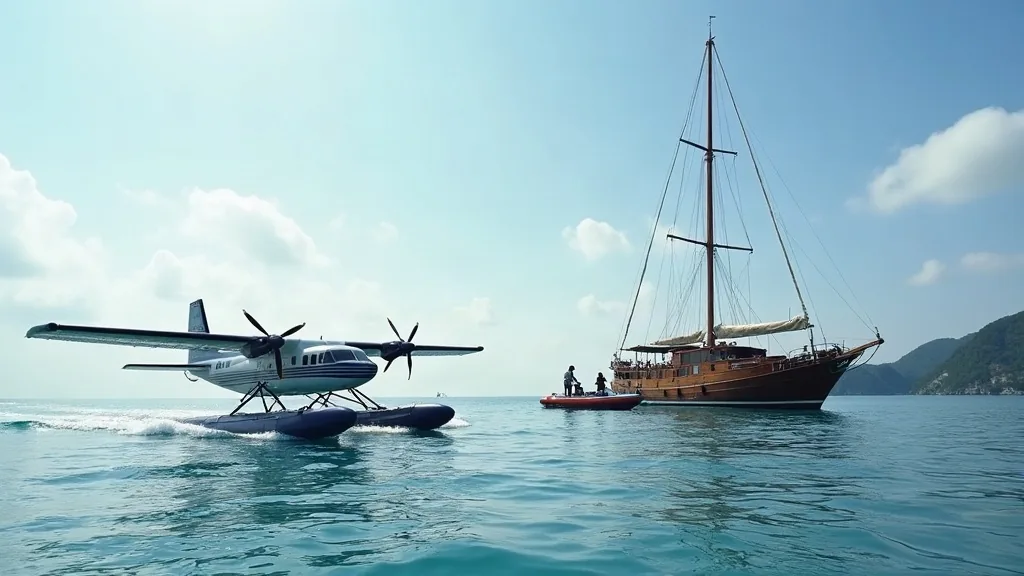
A liveaboard seaplane rendezvous charter flies you from Sorong to calm, open water beside your dive boat’s anchorage, where the tender collects you and carries you to the vessel. Juara Holding Group’s coordination desk (independent broker, est. 2015) sets the meeting point, time window, and radio contact between your cruise director and a licensed seaplane operator — nothing is booked until the operator confirms the approach is clear.
Joining or leaving a liveaboard mid-cruise usually means burning a full sailing day, or missing the Dampier Strait or Misool leg entirely because your flight home doesn’t line up with the boat’s schedule. A seaplane rendezvous is built to close that gap: instead of the boat detouring to Sorong harbor or Waisai on Waigeo Island, the aircraft comes to the boat’s anchorage and a tender does the last hundred meters.
This is a coordination service, not a scheduled flight. As of September 2026, no licensed Indonesian operator publishes a public seaplane tariff, aircraft list, or fixed schedule for Raja Ampat, and no Indonesian seaplane-specific regulation number appears in current public records for this route. Every rendezvous is arranged as a per-flight, written quote from a licensed operator, contingent on the boat’s position, the operator’s aircraft and route capacity, and marine park or resort anchorage approval.
How Is the Rendezvous Point Chosen?
The desk and the operator work backward from three non-negotiables: a protected bay or channel with calm water, at least 15 minutes of clear, obstruction-free approach line, and a landing scheduled strictly within daylight hours. A 2027 UHNW yacht-charter planning guide describes this as a “seaplane direct to anchor point” concept — a chartered amphibian such as a Cessna Caravan EX Amphibian or Quest Kodiak Amphibian departing a Sorong floatplane base and touching down beside a phinisi’s anchorage, with guests stepping straight to the tender. That guide is planning material from a commercial source, not a regulatory or meteorological authority, and it names no specific operator as guaranteed.
Northern Raja Ampat’s calmer window, typically cited as October through April, is the most workable stretch for this kind of touchdown. Outside that window, or in exposed anchorages along the Dampier Strait’s more current-swept channels, a rendezvous is harder to clear and may need to shift to a more sheltered bay nearby.
What Does the Operator Need From the Boat?
Before any flight is quoted, the operator needs three things from your cruise director: the vessel’s confirmed anchorage position (not just the day’s planned route), a tender ready to launch on short notice, and a working radio or phone contact who can hold a go/no-go conversation on the morning of the flight. Liveaboard aggregators note that seaplane charters to certain Raja Ampat resorts are already described as available as of 2026, though without published prices — which is consistent with what the desk sees operator-side: capability exists, but every job is quoted individually.
| Step | Action | Owner |
|---|---|---|
| 1 | Share vessel name, cruise dates, anchorage window, GPS position | Boat |
| 2 | Log the request and match a licensed operator with route capacity | Desk |
| 3 | Review approach line, water depth, and daylight window | Operator |
| 4 | Request marine park or resort anchorage clearance where required | Desk |
| 5 | Confirm radio contact protocol with the cruise director | Boat + Operator |
| 6 | Issue written go/no-go call based on morning sea state | Operator |
| 7 | Collect guest at the calm-water touchdown point | Boat (tender) |
What Happens if Sea State Changes?
Sea state is checked morning-of, not just at booking. If swell, chop, or current at the planned touchdown point exceeds what the operator’s aircraft is rated for, the flight is held or the meeting point is shifted to a more sheltered spot nearby if the boat’s position allows it. If neither works, the rendezvous is postponed to the next viable window in your itinerary, or the guest transfers by boat to Sorong or Waisai instead. This is why the desk asks for cruise dates with some flexibility rather than a single fixed hour — a rendezvous built around one exact minute has no fallback.
| Condition | Go | No-Go |
|---|---|---|
| Sea state at touchdown | Calm water, typically Oct-Apr in northern Raja Ampat | Swell, chop, or strong current |
| Approach line | 15+ minutes clear and unobstructed | Blocked by vessels, reef, or terrain |
| Daylight | Landing falls within daylight hours | Any low-light or after-dark request |
| Approvals | Resort/vessel and marine park sign-off secured | Approval pending or denied |
| Radio contact | Cruise director reachable and briefed | No confirmed contact window |
Which Itineraries Suit a Mid-Trip Join?
A rendezvous fits best where the liveaboard’s route already passes through a broad, sheltered stretch of water — the Dampier Strait near Kri Island and Cape Kri, where Papua Diving’s Kri Eco Resort and Papua Paradise Eco Resort sit, or the southern Misool leg near Misool Eco Resort’s home waters off Batbitim. It fits less well on tight, current-heavy transits between dive sites, where the boat has no reliable calm-water window to hold position.
Guests entering or leaving via Misool Eco Resort separately should note the resort runs its own scheduled speedboat from Sorong (SOQ), departing around 08:00 for a 4-5 hour crossing to Batbitim, priced by a dive travel site, with rates varying per person one-way on scheduled dates, with bundled or complimentary transfers running Fridays and Sundays only. That boat transfer is a different product from a mid-cruise seaplane rendezvous and is arranged directly with the resort, not through this desk.
What Does It Cost Compared to Boat Transfers?
There is no published seaplane tariff to quote against, so the honest comparison is against the liveaboard costs that are publicly documented. Use the table below as cost context, not as a seaplane price.
| Option | Basis | Typical Figure (as of 2026) | Source Note |
|---|---|---|---|
| Seaplane rendezvous charter | Per flight, written quote | No published Indonesia-wide tariff exists | Quoted per request by a licensed operator via the desk |
| Liveaboard whole-vessel charter | Per night, crew, chef, dive guides included | USD 4,500-22,000/night | Per a luxury expedition liveaboard provider covering Raja Ampat, Misool, and Cendrawasih Bay |
| Liveaboard shared berth | Per person, 7-night low season | Approximately USD 2,500/person | Representative figure, not a seaplane price |
| Misool speedboat transfer | Per person, one return trip, scheduled dates | Approximately quoted on request | Per a dive travel booking site, Fri/Sun departures only |
How Booking Works
- Send your vessel name, cruise dates, and cruise director’s contact to the desk via WhatsApp or email.
- The desk checks the request against your itinerary’s Dampier Strait or Misool leg for a workable anchorage window.
- A licensed operator reviews the anchorage, approach line, and daylight window, then issues a written per-flight quote.
- You confirm the flight window with your cruise director and share it back to the desk.
- On the morning of the flight, the operator issues the final go/no-go call based on sea state, and the tender is briefed to launch.
Ready to check a rendezvous window for your cruise? Send your vessel name, cruise dates, and cruise director’s contact to Juara Holding Group’s concierge desk on WhatsApp at +62 811-3941-4563 or bd@juaraholding.com. The desk is an independent coordination service — it arranges the flight with a licensed operator and confirms feasibility before any price is locked in; it does not own or operate the aircraft.
Waisai on Waigeo Island and Sorong harbor remain the standard, always-available boat embarkation points for Raja Ampat liveaboards. A seaplane rendezvous is a bespoke, weather- and approval-dependent option layered on top of that standard route, not a replacement for it — and it is arranged separately from a full yacht charter booking, which follows its own planning process.
Frequently Asked Questions
How far in advance should we request a liveaboard seaplane rendezvous in Raja Ampat?
Contact the desk as soon as your cruise dates are fixed, ideally several weeks out, so there is time for the operator to review the anchorage and approach line and for marine park or resort approvals to clear. Late requests can still be tried, but they carry a higher chance of no viable window before your cruise ends.
Can the seaplane land anywhere along our route, or only at fixed points?
There are no fixed public landing points; each spot is assessed individually against the same three conditions — calm water, 15 or more minutes of clear approach, and daylight. A broad, sheltered stretch like the Dampier Strait near Kri Island is more workable than a narrow, current-heavy channel.
What happens to our booking if the rendezvous is cancelled for sea conditions?
The operator issues a written go/no-go call the morning of the flight. If conditions fail, the desk first tries a nearby sheltered alternative within your boat’s reach; if none exists, the flight is rescheduled to the next viable window in your itinerary or the guest transfers by boat to Sorong or Waisai instead.
Does our cruise director need special equipment to coordinate with the seaplane?
No special equipment is required — a working phone or marine radio and a confirmed contact window are enough. The desk and operator handle the technical approach and clearance planning; the cruise director’s role is holding position, briefing the tender, and staying reachable during the confirmed window.
Is a seaplane rendezvous cheaper than sailing the full liveaboard itinerary?
There is no published seaplane tariff to compare directly, so cost depends on your specific route and the operator’s quote. What is documented is liveaboard pricing itself: whole-vessel charters run roughly USD 4,500-22,000 per night, and a representative low-season shared berth runs about USD 2,500 per person for seven nights, according to a luxury expedition liveaboard provider.